
TL;DR
- Building the bots is the easy part now. What decides whether an AI assistant helps or hurts is placement: where it sits, what it holds, what it can touch, and who signs off on what it sends.
- Microsoft mapped first, then deployed the agents. Its cloud supply chain team simplified end-to-end workflows and built one source of truth before putting more than 100 agents to work, and cut cycle time by up to 75% in selected workflows. Full item in Ops Intel.
- Run the five-question screen on one assistant this week. Pick the AI tool your team uses most, answer the five questions below in one meeting, and write down who approves what it sends.
A couple of weeks ago I admitted, on the podcast, that Claude had burned through my tokens before noon, because “Normally I have five different things running at the same time.” As I write this, those five things have become seven AI agents with names, a chief of staff and an org chart.
I’ve spend years inside operations deciding which work goes to which system, and who signs off before anything moves. Now we build AI systems inside operations that never had that discipline, and the surprise of this year is not that the tools got smarter. It is that building them stopped being the hard part.

My agent stack
I built mine on Grok. Fast, efficient, intuitive, and I can control permissions easily, which was not my experience with Instinct.
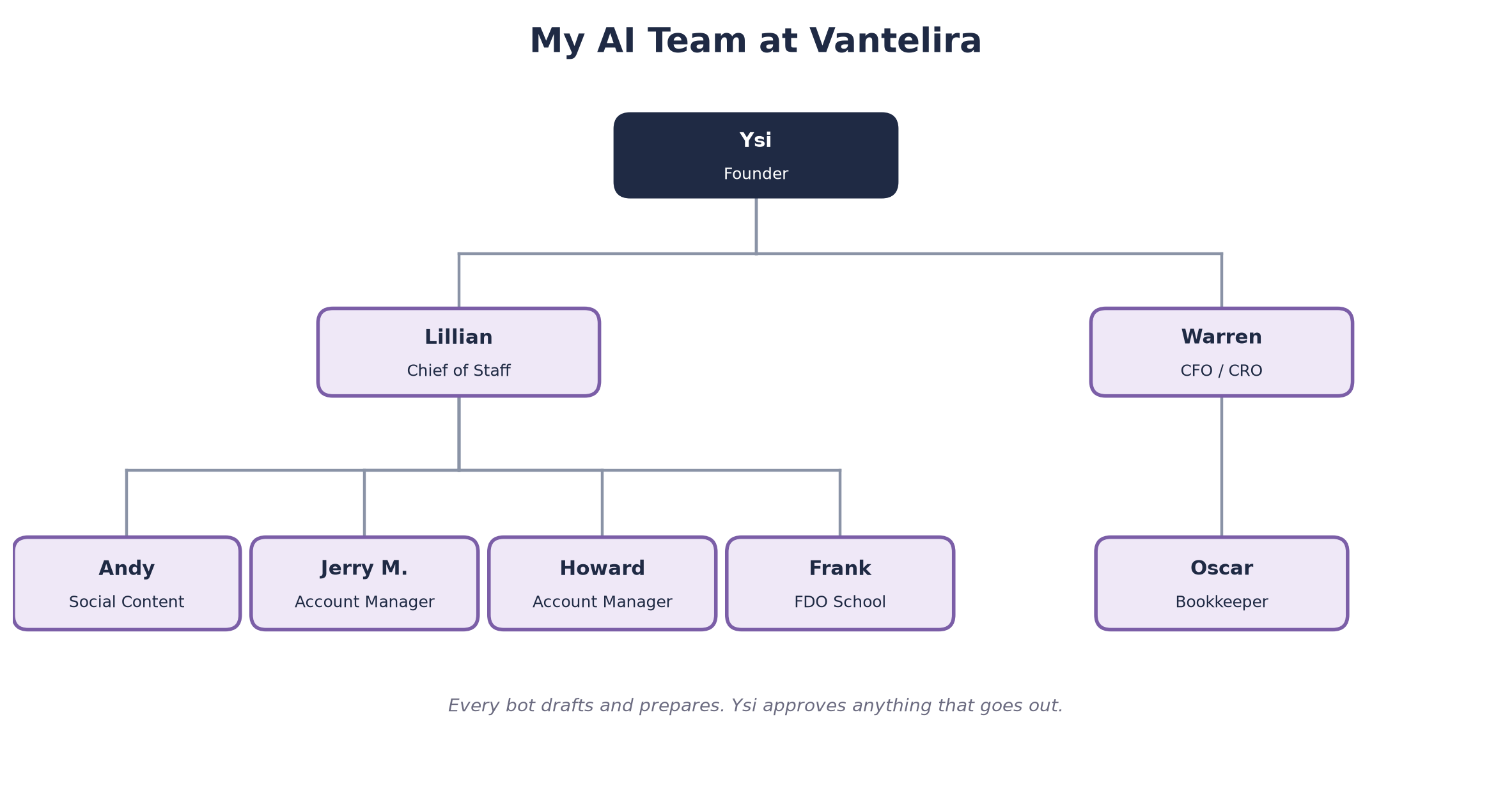
My AI team at Vantelira. Lillian, my chief of staff (calendar and follow-ups too), runs Andy (social content), Jerry M. and Howard (account managers), and Frank on FDO School. Warren, my CFO/CRO, covers finance and revenue, with Oscar on bookkeeping. Every bot drafts and prepares. I approve anything that goes out.
That is how fast this is moving. Within a few months the stack on my side of the table looked nothing like five tools fighting for the same tokens. It looked like roles, reporting lines and a sign-off rule.
Three assistants, three different lessons
I have used all three this year. Here is what each company says its product does, next to what I ran into. Read the second row as one operator’s experience, not a benchmark.
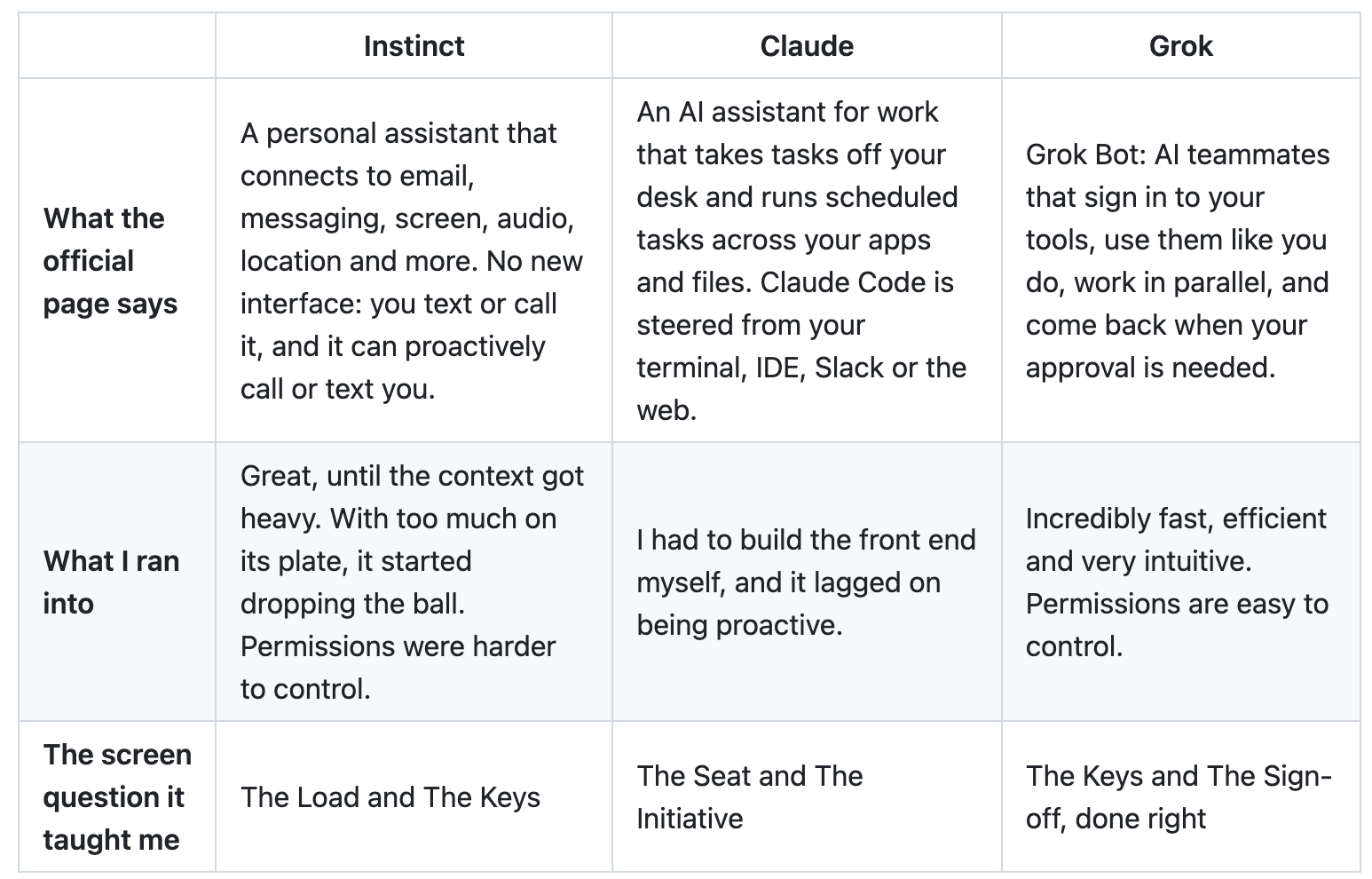
Notice what is missing from that table: which model is smartest.
Not one of my frustrations was about intelligence. Every single one was about placement.
The problem at scale: buying by demo
Most teams are choosing AI assistants the way they used to choose software. Somebody sees a great demo, a few people sign up, and the assistant lands inside a process nobody has mapped.
If nobody agrees on where the work sits and who owns the output, AI simply produces inconsistent results faster.
I learned the Keys question on my own builds. More than once a coding assistant told me "done, committed and pushed" when I had never asked it to push. Another time I asked one to fix a single bug, and it came back with a quiet change to who was allowed to do what inside a client app. A second reviewer caught it before release. Nothing was wrong with the model. I had left the door wide open. Now every assistant can draft and commit, and nothing ships until a human approves it.
We wrote in August that most teams already have the AI and nobody has pointed it at the work (Your Team Already Has the AI. Nobody Pointed It at the Work.). The pointing got easier since then. Standing up a bot team is now something a founder can do on her own. What did not get easier is deciding where each bot fits, and that decision is the Forward Deployed Operator’s job.
On the podcast I put it this way: “You’re managing your team of agents doing the not-so-valuable work, and you, the human, stay in the pilot position.”
So treat every assistant like a hire. Interview it before it gets a seat.
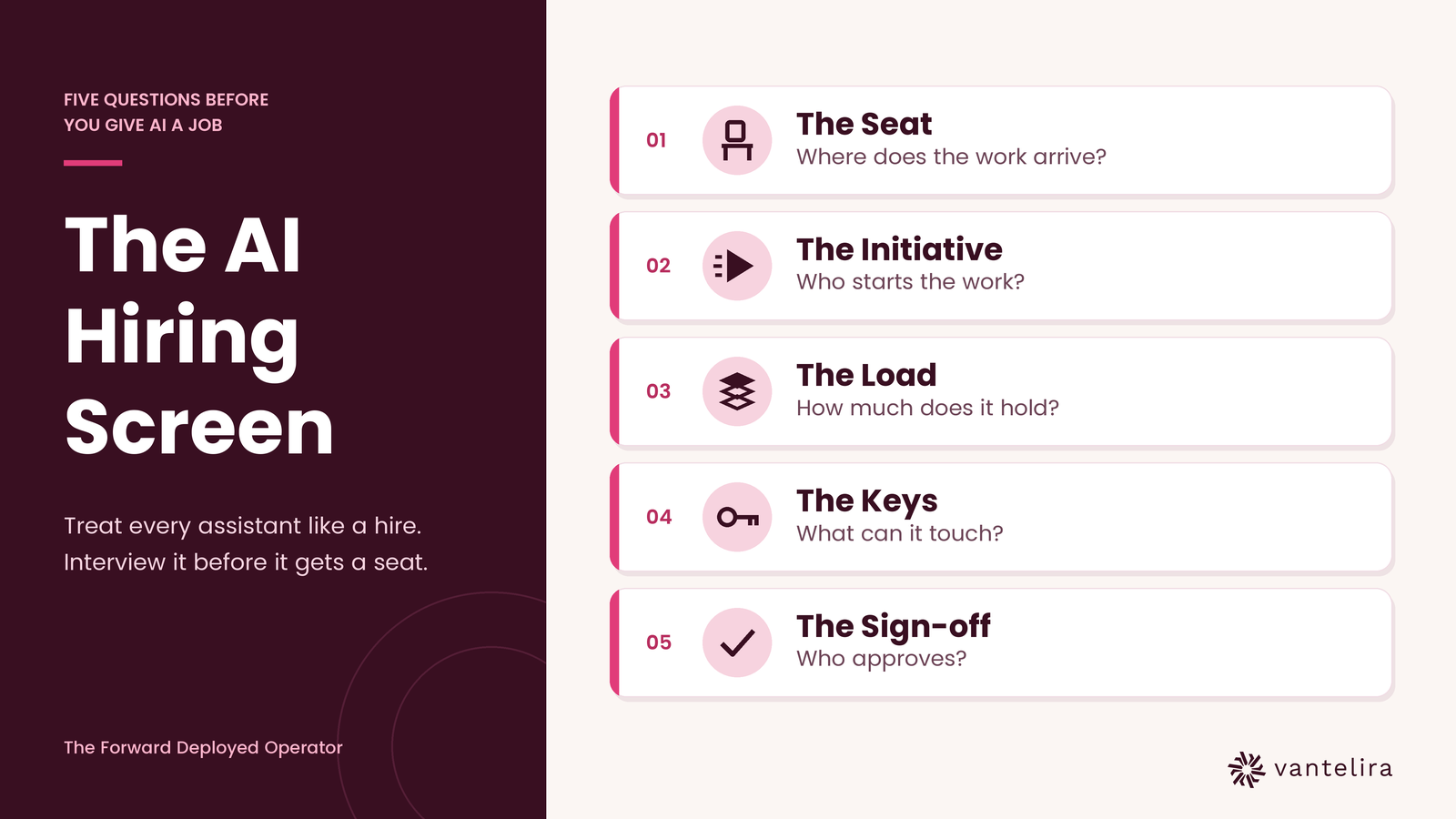
The AI Hiring Screen
Five questions. Ask them about any assistant, for any job, before it touches real work. They take one meeting and no tooling.
1. The Seat: where does the work arrive? An assistant your team has to go find is an assistant your team will forget. Instinct’s whole design is that there is no new interface: you text or call it. With Claude, I had to build the front end myself before it fit the way I work. Neither is wrong. But if the seat does not match where the work already shows up, adoption dies quietly.
2. The Initiative: who starts the work? Some jobs need a bot that moves first. Follow-ups, reminders, the thread that went quiet. Others need a bot that waits to be asked, especially anything that touches money or customers. Claude lagged on being proactive for me, which is a problem for a follow-up job and a feature for an approval job. Decide which one the job needs before you pick the tool.
3. The Load: how much does the job ask it to hold? Instinct was great for me until the context piled up, and then it started dropping the ball. Real talk: so do people. The fix is the same for both. Split the job, and keep the memory outside anyone’s head: where the information is stored, how often it is updated, and who updates it. That is also why my stack has a chief of staff and specialists instead of one giant assistant.
4. The Keys: what can it touch, and can you take the keys back? This is the question I underestimated. Controlling permissions on Grok has been easy. On Instinct, it was not, for me. Grant access per job, not per person, and make sure you can revoke it in one step. We covered the control side of this in SOX for Agents: know who did what, whether they were allowed to, and what evidence you have afterward.
5. The Sign-off: who approves what goes out? We do not want AI making the decisions that matter. When it is time to make one, it has to be routed to a human, and we need to know who that human is. On my org chart, that rule is the footer. Every bot drafts and prepares. I approve anything that goes out.
What changed when I ran the screen on my own stack
I am not going to hand you a productivity number. Almost nobody can measure the hours AI saves yet, and I would rather show you what changed in my week.
My social signals arrive every evening, ready for review. Receipts and invoices get gathered and prepared for the books. Follow-ups get tracked without me keeping a list in my head. None of it goes out until I say so.
Oscar, my bookkeeper, now checks receipts and expenses on a weekly basis. Warren, my CFO, keeps the business plan updated. They flag anything that looks off. Warren already found about $200 of expenses we could cut, and I actioned it over the weekend.
And when something breaks, I know exactly which seat to look at, because every bot has one job, one set of keys and one place on the chart. And every line on that chart ends with me. And of course they keep everything documented. Next week I’ll go deeper on that.
📌 SAVE THIS: “Don’t ask which AI is smartest. Ask where it sits, what it holds, what it can touch, and who signs off.”
Monday morning action plan
- List every AI tool your team uses. Include the ones nobody approved. You cannot place what you cannot see.
- Run the five questions on the one used most. One meeting, the people who actually use it, no tooling. Write the answers down.
- Name the sign-off owner. For each assistant, write down the human who approves what it sends, and put it where the whole team can see it.
If you do not know where to start, start anyway. There is no perfect first step. Pick one assistant and run the screen.
Anyone can build an agent stack now. What is important is to decide their role and who it reports to.
If you’re going to use this framework, I want to hear about it. Reply and tell me what you’re working on.
P.S. This is the work I train, on real operations, not case studies. FDO School is an 8-week live cohort where you go inside an actual company, fix a real problem, ship a working AI system, and leave with the build, the case study, and the title: Forward Deployed Operator.
OPS INTEL
Six signals from the last three weeks on AI agents inside real operations.
Microsoft mapped and simplified its supply chain before deploying more than 100 agents ↑ Sep 17, 2026. The cloud supply chain team mapped and simplified end-to-end workflows and built a single source of truth first, then cut average cycle time from about 10 business days to under 2.5 in selected workflows (company-reported). The headline is the agent count. The lesson is the order of operations.
Loadsmart launches freight agents with human operators behind them ↑ Sep 17, 2026. Loadsmart says roughly 80 percent of what its agents touch is resolved without a person, and its own CTO said the quiet part: “A workflow that’s 80 percent automated still lands the other 20 percent on somebody’s desk.” Before you buy, ask whose desk.
Flexport opens its platform so your AI agents can track, quote and book freight 👀 Sep 29, 2026. Businesses can now connect Claude, ChatGPT, Microsoft Copilot or their own agents and book shipments in plain language, with every exception routed to a human expert. Your assistant just got the keys to a freight account. Decide who holds the spare set.
SPS Commerce makes its agentic layer MAX generally available ↑ Sep 15, 2026. Its onboarding agents run on network data, and consultants review and approve every recommendation before it is applied. That is the Sign-off question answered in the product design, which is exactly where it belongs.
Levelpath’s Ranger runs procurement workflows end to end 👀 Sep 30, 2026 (company post). Agents run sourcing, contracts, supplier onboarding, risk review and invoices end to end, and pause for human approval where required. “Where required” is doing a lot of work in that sentence. Write down where, before the vendor does it for you.
SCMR: in exception management, the level of autonomy must match the risk ↓ Sep 30, 2026. The authors point to the same profile behind every early win: high volume, well-understood rules, a measurable cost of delay and a clear boundary on what the agent may decide. One autonomy setting for every workflow should be on its way out.
Also this week: Episode 11 is live — mapping how work actually flows before you add AI agents. Watch, listen or read the transcript if you want the conversation behind this week’s thinking.