
TL;DR
- Most teams already have the assistant. It sits in a browser tab and gets used like a search engine, while the actual work stays in email threads and in one person’s head.
- Connect it to where the work already lives, then start with triage rather than automation. Ranked, not summarized.
- The procedure nobody wrote is usually already written. It is sitting in the thread from the last time you ran it.
- End every instruction with a request for the plan before the action. That one habit is the difference between an assistant and a mess.
Two operators sat down with us on a video call in late July. Between them they run the orders, the inventory, the supplier email and the shipping paperwork for a growing business. They already had an AI assistant open in a browser tab. They had been using it the way you use a search engine, and it had changed nothing about their week.
That is the normal state of things, and it is worth being plain about why.
We are Vantelira. We are forward deployed operators. We go inside a business, learn how the work actually happens, and build the system that keeps the fix in place. When a team tells us the AI has not helped, the tool is almost never the reason. The assistant had no idea what the work was. Nobody had pointed it at anything.
Two things usually go wrong before we get there. Someone hands the team a login and calls it enablement. Or someone builds a custom workflow nobody asked for, when a shared page and an assistant would have done the same job by Friday. Both skip the part that matters, which is the forty minutes where the tool meets the actual operation.
This is what those forty minutes look like.
Connect it to where the work already lives
Mail. The shared drive. The calendar.
An assistant that cannot see your work can only give you advice about work in general, which is why generic advice is all most people ever get out of one. The first thing we do is give it access to the three places the operation already lives. Nothing is automated yet. It can simply see.
The change is immediate and it is not subtle. The same question that produced a paragraph of management theory an hour ago now produces an answer about your Thursday.
Start with triage, not automation
The first useful instruction of the day is not an automation. It is a question:
Read today’s mail and tell me what genuinely needs an answer today. Rank it. Do not summarize it.
Ranked is the word doing the work. A summary tells you what arrived. A ranking tells you what to do, and it surfaces the two orders that have to ship today ahead of the eleven things that merely feel urgent.
Teams get value from this on day one, which matters more than it sounds. Adoption does not survive a tool that pays off in six weeks.
Teach it your voice before you let it draft
Point it at how you already answer customers and suppliers, then let it draft.
Operators have a register. It is short, it is direct, it confirms dates and quantities, and it does not apologize for three lines before getting to the point. An assistant that has read fifty of your real replies writes in that register. One that has not will write something polite and useless that you rewrite from scratch, and after the third time you stop asking.
Reconstruct the procedure from a thread you already finished
This is the step that changes how a team sees the tool.
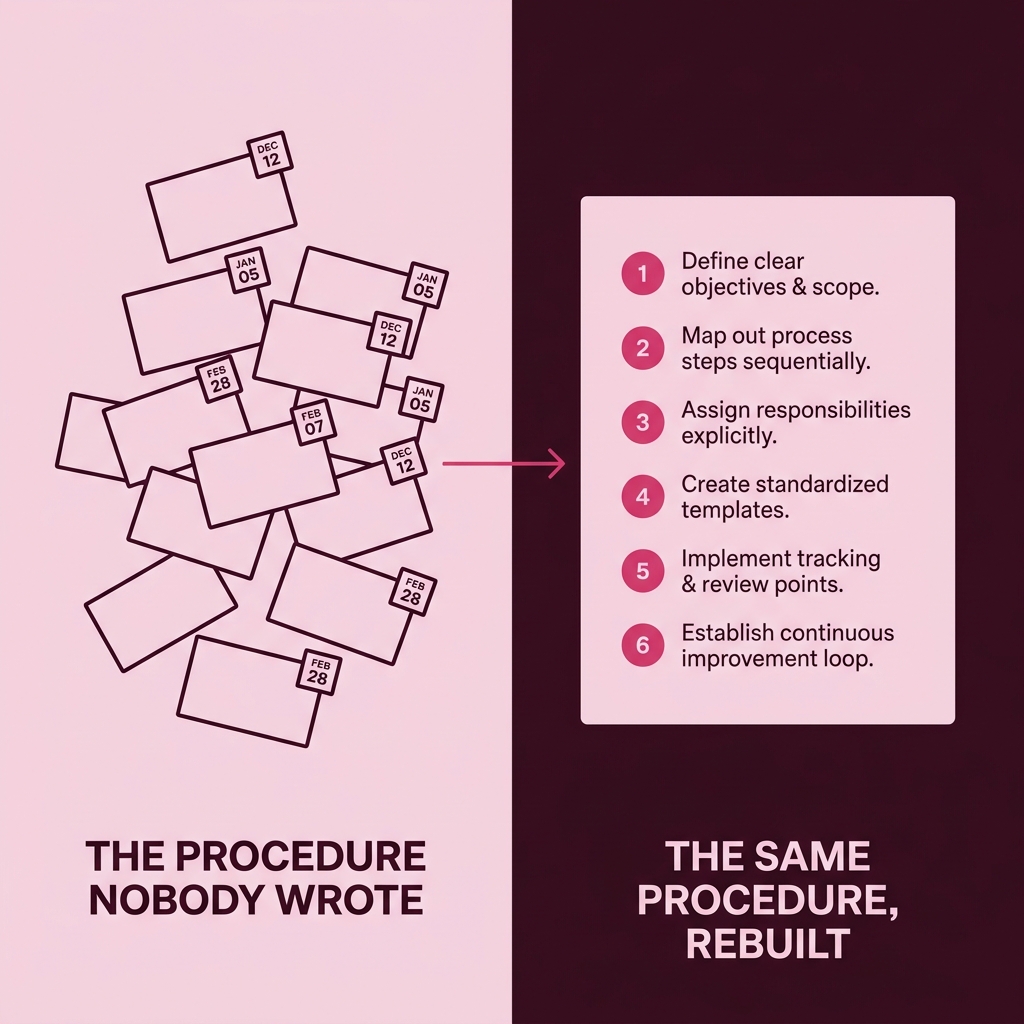
Every business has procedures nobody has written down. The cross-border shipment, the new supplier setup, the seasonal changeover. Each of them ran recently, and each of them is documented. It is just documented as a mess of forty emails across three months.
So ask for it back:
Go through this thread and rebuild every step that was actually taken, in order, as a clean procedure.
It will get you to roughly ninety-five percent. It will miss a step, or compress two into one, or state something with more confidence than the thread supports. That is fine, and it is worth saying plainly rather than pretending otherwise. You correct the last five percent the next time you run the process, which is the only moment you would have caught it anyway. Ninety-five percent of a procedure you did not have beats a blank page you have been meaning to fill for two years.
Then save it back where the team already looks. A procedure living in a chat window is not a procedure.
Make it show you the plan before it acts
End the instruction with one line:
Tell me how you will approach this before you do it.
This is the habit we install in every team, and it is the one people skip.
The failure we see most often is not a tool being wrong. It is someone sending the instruction and their unstated assumption in the same breath, getting back something that is not what they pictured, and concluding the thing does not work. The ask was ambiguous. Nothing checked before the work began.
Asking for the plan first makes the interpretation visible while it is still cheap to correct. You read one short paragraph and say no, not those files, these ones. Ten seconds, and the next thing that happens is the thing you wanted.
Put shared work in a shared place
If two people are running the same part of the operation, they should not be asking the same question in two separate windows and getting two different answers.
Put the relevant files in one shared project and let both of them work there. This sounds like housekeeping. It is actually the difference between one assistant and two slightly divergent versions of the truth, which is the exact problem you were trying to solve.
What you can do this week
Take the last process you finished that nobody has written down. Open the thread. Ask the assistant to rebuild the steps in order, correct the two things it gets wrong, and save the result where your team already looks for things.
That is one procedure out of somebody’s head and into the business, in about twenty minutes.
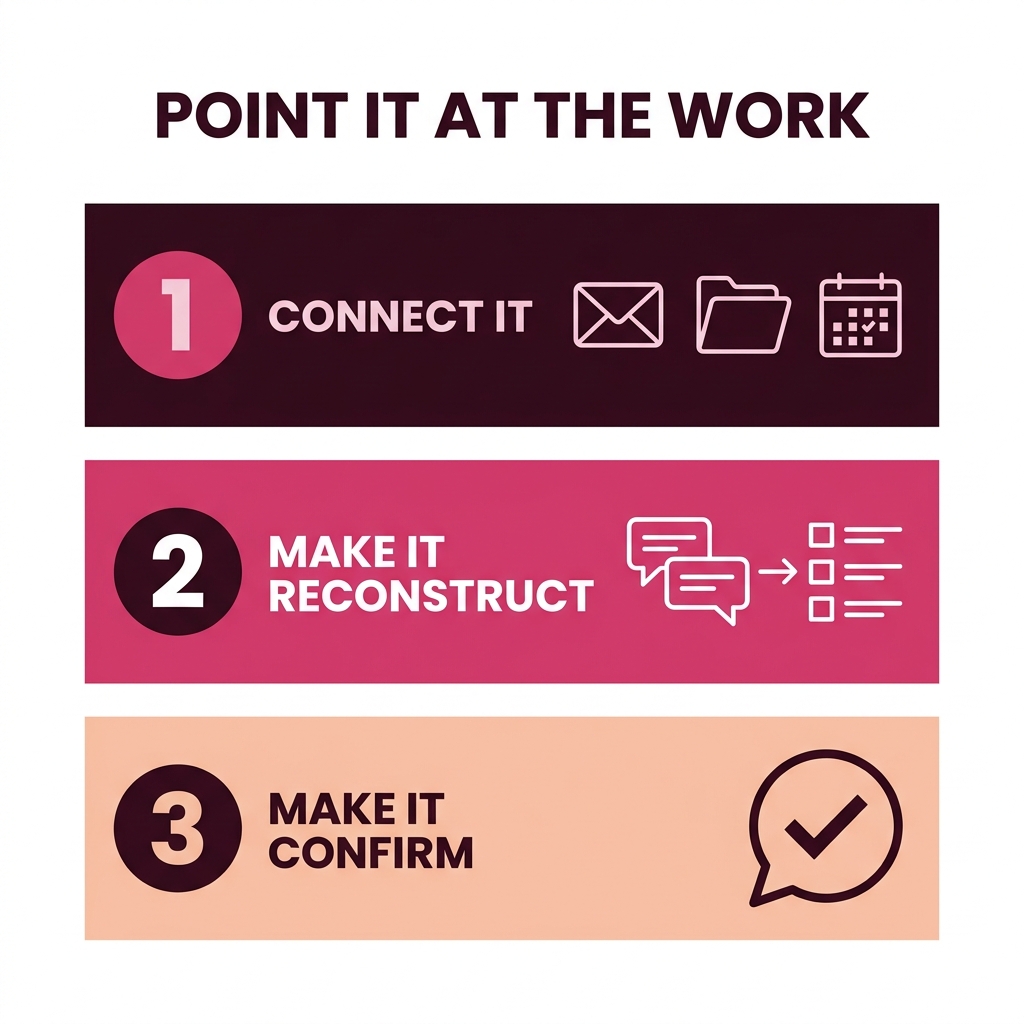
Connect it. Make it reconstruct. Make it confirm. Three moves, in that order, and the tool your team already has starts doing work your team actually recognizes. The point was never the assistant. It was getting the operation out of everyone’s inbox and into a place the next person can pick up.
On this week’s episode
Emma Lukian, co-founder of Good Big Nice, spent close to five years being told no by every co-packer she called. Her own competitors told her it could not be done.
The turn came when she stopped looking for a factory that already worked and started looking for a partner curious enough to build one with her. She found them almost immediately.
She also names the number she wishes she had been able to see from year one. It is not revenue.
🎧 The Forward Deployed Operator, Episode 2: What to Do When No Co-Packer Will Take Your Product → https://vantelira.com/podcast/what-to-do-when-no-co-packer-will-say-yes/
New episodes drop every Tuesday.
Ops Intel
👀 Small business AI use climbed again last quarter (OnDeck Small Business Cash Flow Trend Report, July 31). Sixty-one percent of small businesses now report using AI, up from 58 percent in the first quarter, and 91 percent of those users say the impact on the business has been positive. Adoption has stopped being the interesting number. What the tool is pointed at is the number that separates the 91 percent from everyone else.
👀 Two thirds of small businesses use AI, and seven in ten say they need more training to use it well (Thryv 2026 AI and Small Business Adoption Survey, reported July 15). Adoption reached 66 percent across 561 owners and decision-makers, up from 55 percent a year ago, while 70 percent said they still need training to get real value out of it. The gap is not access to the tool. It is knowing what to ask it for, which is the entire subject of this issue.
↓ Ocean freight kept sliding through the end of July (Drewry World Container Index, July 30). The composite fell 3 percent to 4,255 dollars per 40ft box, on softer Asia to Europe and transpacific rates. If you are holding a freight quote written before mid-July, ask for it again before you approve it.
👀 Canadian factory sales rose across most subsectors in May (Statistics Canada, July 15). Sales climbed in 13 of 21 subsectors, led by transportation equipment at 7.0 percent and chemicals at 9.4 percent. June figures do not land until August 14, so this is your most recent confirmed read rather than your current one, and worth saying out loud in any planning meeting that treats it as live.
↑ Store brands took a record share of the basket in the first half (Food Industry Executive brief, July 17). Private label reached 23.8 percent unit share in the first half of 2026 while consumer goods prices ran 3.4 percent above last year for a third straight month. If you sit on a shelf next to a store brand, your margin file needs to be current going into the next price conversation, not reconstructed after it.
Vantelira. A forward deployment operations firm. We embed. We build. We stay until the system runs.